
Methylene blue was first synthesized in 1876. It has been used as a textile dye, a malaria treatment, a surgical stain, and an antidote for methemoglobinemia. Its newest application — topical skincare — is grounded in research that most brands in the category barely reference.
Research
Ingredient Science10 min read
Methylene Blue in Skincare: Mitochondrial Science Meets Topical Application
Methylene blue is a synthetic electron carrier with a unique catalytic antioxidant mechanism. Unlike sacrificial antioxidants, it cycles repeatedly between oxidized and reduced states, bypassing leaky mitochondrial complexes to reduce ROS and maintain ATP production. This article covers the published mechanism, the specific studies, the concentration question, and what the evidence actually supports.
February 16, 2026
Key Takeaways
Methylene blue is a synthetic electron carrier with a unique catalytic antioxidant mechanism. Unlike sacrificial antioxidants, it cycles repeatedly between oxidized and reduced states, bypassing leaky mitochondrial complexes to reduce ROS and maintain ATP production. This article covers the published mechanism, the specific studies, the concentration question, and what the evidence actually supports.
This article covers the published mechanism, the specific studies, the concentration question, and what the evidence actually supports.
What is methylene blue?
Methylene blue (methylthioninium chloride) is a synthetic compound that functions as an electron carrier. In biological systems, it can accept and donate electrons — cycling between its oxidized form (blue) and its reduced form (leucomethylene blue, colorless).
This redox cycling capacity is the basis of its biological activity. Unlike most antioxidants that neutralize a single free radical and are “used up,” methylene blue can cycle repeatedly between oxidized and reduced states, functioning as a catalytic antioxidant rather than a sacrificial one.
In pharmacology, methylene blue has FDA approval for treating methemoglobinemia (a blood disorder) and is used as a surgical dye. Its application in skincare is based on more recent research into its effects on skin cell biology — specifically its interaction with mitochondria.
The mitochondrial mechanism
Methylene blue’s skincare relevance begins inside the mitochondria — the organelles in your cells that produce energy (ATP) through the electron transport chain.
How the electron transport chain works
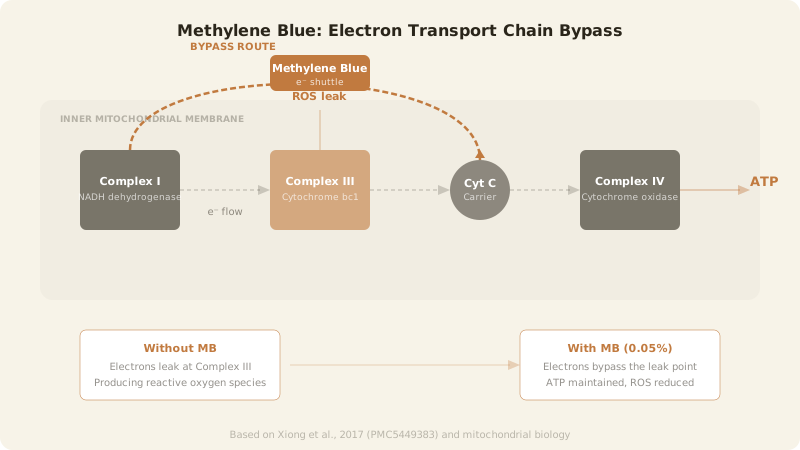
Your mitochondria produce energy by passing electrons through a series of protein complexes (Complex I through Complex IV). This electron flow drives the production of ATP, your cells’ energy currency. As a byproduct, this process also generates reactive oxygen species (ROS) — free radicals that, in excess, damage cellular structures including DNA, proteins, and lipids.
With aging, the electron transport chain becomes less efficient. Electrons “leak” at Complex I and Complex III, producing more ROS and less ATP. The result: cells have less energy for maintenance functions (including collagen synthesis) and more oxidative damage accumulating.
What methylene blue does
Methylene blue acts as an alternative electron carrier. It can accept electrons at Complex I and transfer them directly to cytochrome c (downstream of Complex III), effectively bypassing the sites where electron leakage is most problematic (Xiong et al., 2017, Scientific Reports, PMC5449383).
“A single methylene blue molecule can shuttle electrons repeatedly. It is not consumed in the process — making it a catalytic antioxidant, not a sacrificial one.”
The consequences of this bypass:
• Reduced ROS production. By rerouting electrons around the leaky Complex I and III, methylene blue decreases the generation of superoxide radicals (Cao & Bhatt, 2021, Cells, PMC8699482).
• Maintained ATP production. The electron flow continues to Complex IV, preserving energy production even as the native transport chain becomes less efficient with age.
• Catalytic recycling. Because methylene blue cycles between oxidized and reduced forms, a single molecule can shuttle electrons repeatedly. It is not consumed in the process.
Why this matters for skin
Skin fibroblasts — the cells that produce collagen, elastin, and the extracellular matrix — are energy-intensive. Collagen synthesis requires significant ATP. As mitochondrial efficiency declines with age, fibroblast capacity to produce structural proteins declines in parallel.
By supporting mitochondrial electron flow and reducing oxidative stress, methylene blue addresses both sides of the aging equation: energy supply for synthesis and protection from oxidative damage.
What the published research shows
Xiong et al., 2017 — The landmark skin study
The most frequently cited study for methylene blue in skincare is Xiong et al., “Anti-Aging Potentials of Methylene Blue for Human Skin Longevity,” published in Scientific Reports (PMC5449383).
Study design: Human dermal fibroblasts treated with methylene blue in culture, plus a 3D skin tissue model.
Key findings:
• Methylene blue at 0.5 µM delayed cellular senescence in human dermal fibroblasts.
• MB stimulated proliferation of human dermal fibroblasts more effectively than other widely used antioxidants tested in the study, including N-acetyl cysteine (NAC) and MitoQ.
• MB increased collagen expression (COL2A1) and elastin expression in treated fibroblasts.
• In 3D skin tissue models, MB treatment resulted in increased skin thickness and reduced markers of aging.
• The optimal concentration in cell culture was 0.5 µM.
Limitations to note: This is primarily an in vitro study. In vitro results demonstrate mechanism and biological plausibility, but they are not the same as clinical trials.
Cao & Bhatt, 2021 — Review of anti-aging mechanisms
Cao and Bhatt published a comprehensive review, “The Potentials of Methylene Blue as an Anti-Aging Drug,” in Cells (PMC8699482).
Key points:
• MB functions as a mitochondrial-targeting antioxidant with a unique mechanism.
• MB reduces mitochondrial ROS production at Complex I and III.
• Evidence supports effects on cellular senescence delay across multiple cell types.
• The review emphasizes MB’s potential for skin longevity but notes the need for more clinical data.
The evidence picture
The published evidence for methylene blue in skincare is mechanistically strong but clinically early. The mitochondrial mechanism is well-documented. What is missing is a large body of randomized controlled clinical trials specifically studying topical MB formulations on human facial skin.
Concentration: What the research uses and what products contain
In vitro concentrations
The Xiong et al. study identified 0.5 µM as the optimal in vitro concentration — approximately 0.00016% w/w.
Topical application range
The established safe range for methylene blue in cosmetic topical formulations is 0.01–0.1% (100–1,000 ppm).
• 0.01% (100 ppm): Lower end. Minimal visible color.
• 0.05% (500 ppm): Mid-range. Light blue tint.
• 0.1% (1,000 ppm): Upper end. More visible blue color.
The staining question
At 0.05% and below, normal application amounts do not cause visible skin staining.
USP grade vs. industrial grade
For skincare, USP grade is the appropriate standard — pharmaceutical-quality material with verified purity.
Methylene blue and GHK-Cu: Complementary mechanisms
GHK-Cu stimulates collagen synthesis, regulates MMP-mediated remodeling, and signals fibroblasts to produce new structural proteins. It is an active building signal.
Methylene blue protects the cellular machinery that produces those proteins. By supporting mitochondrial function and reducing oxidative stress, it ensures fibroblasts have the energy and protection needed to respond to GHK-Cu’s building signals.
“One ingredient tells cells to build. The other ensures cells have the resources to do so.”
The combination makes formulation sense: one ingredient tells cells to build, the other ensures cells have the resources to do so.
No published study has directly tested this specific combination in a controlled clinical trial. The rationale is mechanistic, not clinical. That distinction matters.
Frequently asked questions
Will methylene blue stain my skin?
At concentrations of 0.05% and below, normal application amounts do not cause visible skin staining.
Is methylene blue safe for topical use?
Methylene blue has FDA approval for medical uses and a long safety history. In cosmetic topical formulations at 0.01–0.1%, it is within the established safe-use range.
How does methylene blue compare to retinol?
Different mechanisms entirely. Retinol works through nuclear receptor activation. Methylene blue works through mitochondrial electron transport. They address different aspects of skin aging.
What concentration should I look for?
The 0.01–0.1% range is the established topical application window. 0.05% represents a balanced midpoint.
References
Xiong, Z.M., et al. (2017)
Anti-Aging Potentials of Methylene Blue for Human Skin Longevity
Pickart, L., Margolina, A. (2018)
Regenerative and Protective Actions of the GHK-Cu Peptide
Continue reading
Peptide Science
The Complete Guide to GHK-Cu in Skincare
Your skin already makes GHK-Cu. It just makes less of it every year.
18 min read
Consumer Guide
Why Skincare Concentrations Matter (And Why Most Brands Hide Them)
You wouldn’t buy a vitamin supplement that said “Contains Vitamin D” without the dose. That’s exactly how most skincare is sold.
9 min read
Curious about the product?