
You started using a GHK-Cu product two weeks ago. Your skin looks worse. The fine lines you were trying to reduce seem deeper. Your texture is rougher. You are considering throwing the product away.
Research
Peptide Science9 min read
The Copper Uglies: What’s Actually Happening to Your Skin
The “copper uglies” is a temporary worsening of skin appearance in the first 2–6 weeks of GHK-Cu use. It is not damage — it is the demolition phase of collagen remodeling, where MMP-mediated breakdown temporarily outpaces new collagen synthesis. This article explains the mechanism, timeline, and how to manage it.
February 16, 2026
Key Takeaways
The “copper uglies” is a temporary worsening of skin appearance in the first 2–6 weeks of GHK-Cu use. It is not damage — it is the demolition phase of collagen remodeling, where MMP-mediated breakdown temporarily outpaces new collagen synthesis. This article explains the mechanism, timeline, and how to manage it.
Before you do, understand what is happening at the cellular level — because what looks like damage is often the first phase of remodeling.
What Are the Copper Uglies?
“Copper uglies” is a term used in online skincare communities to describe a temporary worsening of skin appearance after starting GHK-Cu (Copper Tripeptide-1) products. Symptoms typically include:
• Fine lines appearing more visible or deeper
• Skin texture becoming rougher or uneven
• Mild dryness or flaking
• Overall appearance looking “worse” than before starting the product
This is not an allergic reaction. It is not irritation in the traditional sense. It is a documented physiological response to active collagen remodeling.
The Mechanism: Demolition Before Construction
GHK-Cu stimulates the collagen remodeling cycle. Understanding the copper uglies requires understanding that cycle.
How Collagen Remodeling Works
Your skin continuously turns over its collagen matrix. Old, damaged collagen is broken down by enzymes called matrix metalloproteinases (MMPs), while new collagen is synthesized by fibroblast cells. In healthy, young skin, these two processes are balanced.
With aging and UV exposure, this balance shifts. Old collagen accumulates because your body is less efficient at clearing it. New collagen synthesis slows because fibroblast activity declines.
What GHK-Cu Does to This Balance
GHK-Cu activates both sides of the remodeling equation simultaneously:
Breakdown (MMP activation): GHK-Cu upregulates MMP-2, an enzyme involved in controlled collagen remodeling, while modulating MMP-1 and MMP-9 expression (Siméon et al., 2000, PMID 10886523).
Synthesis (fibroblast stimulation): GHK-Cu upregulates collagen Types I and III production in dermal fibroblasts (Pickart & Margolina, 2018, PMC6073405).
The Timing Gap
MMP-mediated collagen breakdown begins within days of GHK-Cu application. New collagen synthesis also begins quickly at the cellular level — but newly synthesized collagen takes weeks to mature, cross-link properly, and become structurally functional in the dermis.
During weeks 2–6, you may be in a state where:
• Old, damaged collagen is being actively removed
• New collagen is being synthesized but has not yet matured to replace what was removed
The visible result is the copper uglies. Your skin temporarily has less total collagen volume, even though the collagen being built will eventually be better organized and more functional than what was removed.
“This is renovating a house while living in it. The demolition phase looks worse before the construction phase shows results.”
What the Timeline Looks Like
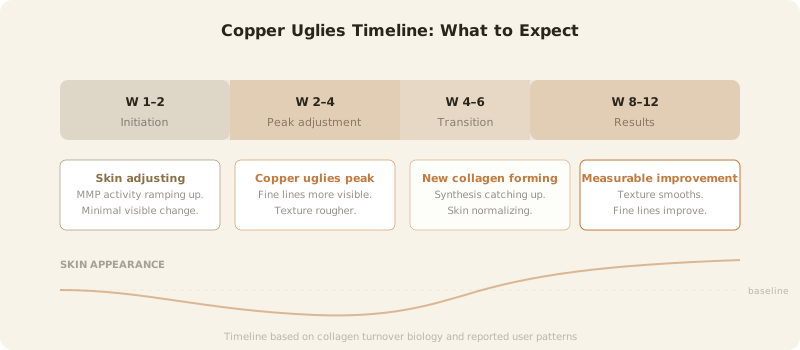
Weeks 1–2: Initiation
Skin is adjusting to GHK-Cu. Gene expression changes are occurring at the cellular level. You may notice no visible change, or mild changes in skin feel.
Weeks 2–4: Peak Remodeling
This is the most common window for copper uglies. MMP-mediated collagen breakdown is active. Fine lines may appear more pronounced. Some users describe a “crepey” appearance.
Weeks 4–6: Transition
New collagen is accumulating and beginning to mature. The copper uglies, if present, typically begin resolving in this window.
Weeks 6–8: Early Improvement
For users who will respond positively, this is when improvement becomes visible. Skin texture smooths. Fine lines that appeared worse during weeks 2–4 begin to look better than baseline.
Weeks 8–12: Measurable Results
8–12 weeks
the evaluation period used in published GHK-Cu studies reporting skin improvement
Published studies reporting skin improvement with GHK-Cu use 8–12 week evaluation periods for this reason. The full remodeling cycle operates on this timeline.
How to Tell the Difference: Copper Uglies vs. Actual Problems
Normal Copper Uglies
• Fine lines appearing temporarily more visible
• Mild textural changes
• Gradual onset over days/weeks
• No pain, burning, or significant discomfort
• No redness, swelling, or hives
• Affects areas where you applied the product
Signs of Actual Irritation or Allergy
• Redness, itching, burning, or stinging that persists
• Hives, welts, or raised bumps
• Swelling
• Sudden onset (within hours)
• Symptoms spreading beyond application area
Tip
If you experience signs from the second list, stop using the product.
When to Consult a Dermatologist
• Any reaction involving swelling around the eyes or lips
• Persistent redness that does not resolve within 24–48 hours of stopping
• Blistering or broken skin
• Any reaction that concerns you
Managing the Adjustment Period
Introduction Protocol
• Week 1–2: Apply every other day, in the evening.
• Week 3–4: Increase to daily application if tolerating well.
• Week 5+: Daily application.
If the Copper Uglies Are Uncomfortable
• Reduce frequency, don’t stop entirely.
• Support the barrier.
• Be patient with the timeline.
What Not to Do
• Don’t add more actives to compensate.
• Don’t increase concentration to speed up results.
• Don’t evaluate results before 8 weeks.
Frequently Asked Questions
Does everyone get the copper uglies?
No. The severity varies widely. Users with more accumulated collagen damage may experience more noticeable remodeling effects.
How long do the copper uglies last?
Typically 2–6 weeks, with peak effects around weeks 2–4.
Do the copper uglies mean the product is working?
Partially. The copper uglies indicate active MMP-mediated collagen remodeling. But absence of copper uglies does not mean the product is ineffective.
Should I push through the copper uglies or stop?
If your symptoms match the “normal copper uglies” profile, reducing frequency and continuing is generally preferable to stopping.
References
Siméon, A., et al. (2000)
Expression of glycosaminoglycans and small proteoglycans in wounds: modulation by the tripeptide-copper complex
Pickart, L., Margolina, A. (2018)
Regenerative and Protective Actions of the GHK-Cu Peptide in the Light of the New Gene Data
Continue reading
Peptide Science
The Complete Guide to GHK-Cu in Skincare
Your skin already makes GHK-Cu. It just makes less of it every year.
18 min read

Peptide Science
GHK-Cu Concentration in Skincare: Why It Matters
A product with 0.001% GHK-Cu and a product with 1% GHK-Cu both say “Copper Tripeptide-1” on the label. They are not the same product.
14 min read
Curious about the product?