
A product with 0.001% GHK-Cu and a product with 1% GHK-Cu both say “Copper Tripeptide-1” on the label. They are not the same product.

Research
Peptide Science14 min read
GHK-Cu Concentration in Skincare: Why It Matters
Concentration is the variable that determines whether GHK-Cu is present in meaningful amounts or exists as a label decoration. This article covers what published research uses, what the commercial market discloses, how INCI labeling rules obscure the data, and how to evaluate products when brands won’t give you numbers.
February 1, 2026
Key Takeaways
Concentration is the variable that determines whether GHK-Cu is present in meaningful amounts or exists as a label decoration. This article covers what published research uses, what the commercial market discloses, how INCI labeling rules obscure the data, and how to evaluate products when brands won’t give you numbers.
Concentration is the variable that determines whether a skincare ingredient is present in meaningful amounts or exists as a label decoration. For GHK-Cu, this distinction is especially important because the difference between an ineffective trace amount and a research-supported dose spans three orders of magnitude.
This article covers what the published research uses, what the commercial market discloses (and doesn’t), how INCI labeling rules obscure concentration data, and how to evaluate products when brands won’t give you numbers.
What concentrations does the research use?
GHK-Cu operates across a wide concentration range depending on the experimental context.
In vitro (cell culture)
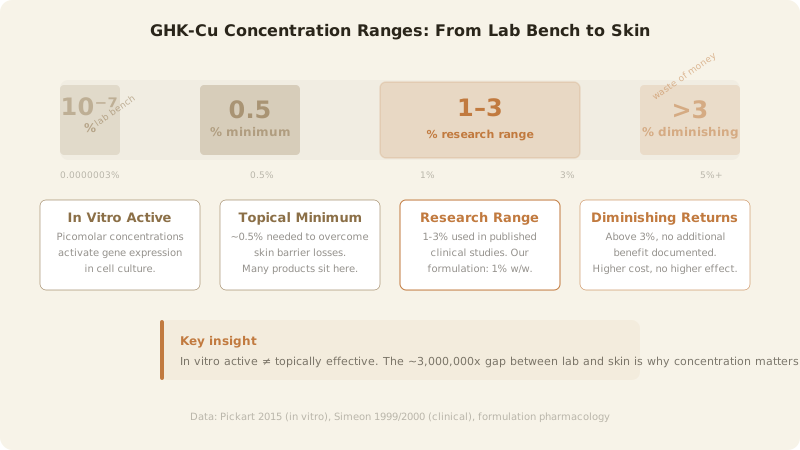
Laboratory studies applying GHK-Cu directly to cells in culture dishes report biological activity at picomolar to nanomolar concentrations (Pickart et al., 2015, BioMed Research International, PMC4508379). These are vanishingly small amounts — a nanomolar solution contains roughly 0.0000003% GHK-Cu by weight.
This number appears impressive until you consider what in vitro means: the peptide is applied directly to cells with no skin barrier to cross, no degradation during transit, and no competition from other molecules. The concentration required at the cell surface is not the concentration required at the skin surface.
In vivo (animal and human studies)
Wound healing studies — where GHK-Cu is applied topically to intact skin — use substantially higher concentrations. The Canapp et al. (2003) ischemic wound study and the Arul et al. (2007) diabetic wound model both used concentrations in the topical application range, not the picomolar concentrations effective in cell culture.
Clinical and OTC formulations
Products reporting measurable skin improvement in structured evaluations typically contain GHK-Cu in the 1–3% range. This is the concentration window supported by the available clinical data for topical cosmetic application. A frequently referenced evaluation reported skin firmness improvement in 70% of subjects over 12 weeks at these concentrations.
70%
of subjects showed skin firmness improvement over 12 weeks at research-supported concentrations
The delivery gap
The difference between in vitro effective concentration and topical applied concentration — roughly 1,000,000x — reflects the delivery challenge. Your skin’s stratum corneum exists specifically to prevent molecules from entering your body. Only a fraction of any applied topical actually penetrates to the viable dermis where fibroblasts produce collagen.
GHK-Cu’s hydrophilic nature (log D between -2.38 and -2.49; Arul et al., PMC3016279) compounds this challenge. It prefers water over oil, but the skin barrier is lipid-based. Getting a water-loving molecule through a fat-based barrier requires either high applied concentration, enhanced delivery technology, or both.
This is why concentration disclosure matters. A trace amount of GHK-Cu faces the same delivery challenge as a meaningful amount — but without enough starting material, the fraction that penetrates may fall below the effective threshold.
The transparency problem in GHK-Cu skincare
What brands disclose
As of 2026, the GHK-Cu skincare market has a transparency problem. Here is what a survey of the competitive landscape reveals:
• Brands disclosing exact concentration: Rare. In our analysis of the major GHK-Cu tallow and serum brands, concentration disclosure remains the exception.
• Brands using vague language: Common. “Contains copper peptides,” “enriched with GHK-Cu,” “powered by Copper Tripeptide-1” — none of these tell you how much.
• Brands disclosing absolute mg amounts per container: Almost nonexistent.
• Brands providing third-party verification (CoA): Effectively zero in the tallow balm category.
This is not an inherent limitation of the industry. Supplement companies routinely disclose exact milligram amounts of active ingredients and provide Certificates of Analysis. The technology and regulatory framework for concentration transparency already exist — skincare brands simply choose not to use them.
Why brands don’t disclose
There are several reasons, and not all of them are cynical:
Cost sensitivity. Higher GHK-Cu concentrations increase formulation cost. A 1% GHK-Cu product uses 100x more peptide than a 0.01% product. Disclosing low concentrations invites unfavorable comparison.
Formulation complexity. Achieving a stable, effective GHK-Cu formulation at meaningful concentrations — especially in lipid-based systems — requires solving real technical challenges. Some brands may lack the formulation expertise to work at higher concentrations.
Industry norms. INCI labeling does not require concentration disclosure. When no one in your category discloses, there is no competitive pressure to start.
Regulatory caution. Some brands worry that disclosing high concentrations of active ingredients might attract FDA scrutiny or create liability if the stated concentration varies between batches. This is a legitimate concern that third-party testing and batch-specific CoAs address.
What this means for you
Without concentration data, you cannot evaluate whether a GHK-Cu product contains enough active ingredient to match what published research uses. You are purchasing on brand trust, packaging aesthetics, and marketing language rather than formulation data.
This is the equivalent of buying a vitamin supplement that says “Contains Vitamin D” without telling you whether it contains 400 IU or 4,000 IU. The presence of an ingredient is not the same as the presence of an effective dose.
How INCI labeling rules obscure the picture
The International Nomenclature of Cosmetic Ingredients (INCI) system governs how skincare ingredients appear on labels. Understanding its rules — and limitations — helps explain why ingredient lists alone cannot tell you what you need to know.
The 1% line
INCI requires ingredients to be listed in descending order of concentration, but only for ingredients present above 1% of the total formula. Below 1%, ingredients may be listed in any order.
GHK-Cu in most products is formulated at or below 1%. This means its position among the last several ingredients on a label tells you almost nothing about its relative concentration. It could be 0.9% or 0.009% — both positions on the label would look identical.
What you can infer
Despite these limitations, INCI lists offer some clues:
• If GHK-Cu (Copper Tripeptide-1) appears near the end of a long ingredient list, it is very likely below 1% and possibly far below. The more ingredients listed after it in the below-1% zone, the less you can infer about any individual concentration.
• If the product has a short ingredient list (8–10 ingredients), GHK-Cu’s position provides somewhat more information, since there are fewer below-1% ingredients competing for the same space.
• Preservatives and fragrance compounds typically appear at 0.1–0.5%. If GHK-Cu is listed after common preservatives, it may be present at very low levels.
These are inferences, not measurements. The only way to know actual concentration is disclosure or testing.
Why “proprietary blend” is a red flag
Some brands list a group of active ingredients as a “proprietary blend” or “active complex” with a combined percentage but no individual breakdown. In the supplement industry, this practice is widely recognized as a way to include headline ingredients at sub-effective doses while using the blend’s total weight to suggest meaningful amounts of each component.
The same logic applies to skincare. A “Peptide Complex” containing five different peptides at a combined 0.5% may include GHK-Cu at 0.1% — one-tenth of the concentration used in published research.
Concentration and the copper uglies
Concentration directly affects the likelihood and severity of the copper uglies — the temporary worsening of skin appearance that some users experience in the first 2–6 weeks of GHK-Cu use.
The mechanism
GHK-Cu stimulates matrix metalloproteinase (MMP) activity as part of the collagen remodeling process (Siméon et al., 2000, Journal of Investigative Dermatology, PMID 10886523). Higher concentrations drive more aggressive MMP activity, which means faster breakdown of existing damaged collagen.
If MMP-mediated collagen breakdown temporarily outpaces new collagen synthesis, the visible result is the copper uglies: more pronounced fine lines and rougher texture during the transition period.
Concentration and risk
• Below 0.5%: Copper uglies are unlikely but so is meaningful collagen remodeling. The peptide may not reach effective dermal concentrations.
• 1%: The lower end of the research-supported range. Copper uglies are possible but typically manageable with proper introduction protocol (start every other day, increase to daily over 2 weeks).
• 2–3%: Higher efficacy ceiling but increased copper uglies risk. More aggressive MMP activity means a potentially more noticeable adjustment period.
• Above 3%: Diminishing returns and increased risk. The dose-response for MMP activation appears nonlinear — higher is not always better.
Why 1% is a defensible starting point
A 1% concentration sits at the effective floor of the research-supported range. It provides enough GHK-Cu to drive collagen synthesis and remodeling while minimizing the severity of the adjustment period. For a first-time GHK-Cu user, this concentration balances efficacy against tolerability.
Brands choosing higher concentrations (2–3%) are not wrong — but they should be transparent about the increased adjustment period and provide clear guidance on introduction protocol. The absence of this guidance suggests the brand may not fully understand the concentration-response relationship.
How to evaluate products on concentration
When you cannot get a direct concentration number, here are evaluation strategies ranked by reliability.
Tier 1: Direct disclosure (most reliable)
• Exact percentage disclosed (e.g., “1% w/w GHK-Cu”)
• Absolute milligrams disclosed (e.g., “567mg GHK-Cu per 2oz jar”)
• Third-party CoA available confirming stated concentration
If a brand provides all three, you have the data needed for an informed purchase decision. Compare the stated concentration against published research (1–3% range) and evaluate accordingly.
Tier 2: Partial disclosure
• Percentage given without third-party verification. Better than nothing, but you are trusting the brand’s internal quality control.
• “Active complex” percentage given without individual ingredient breakdown. Calculate the maximum possible GHK-Cu concentration (total blend percentage divided by number of active ingredients) and assume the actual amount is lower.
Tier 3: Inference from available data (least reliable)
• INCI position analysis. As discussed above, only useful for rough estimates and only when the total ingredient count is low.
• Price analysis. Pharmaceutical-grade GHK-Cu powder costs significantly more than most base ingredients. A $15 product with 12 ingredients including GHK-Cu is unlikely to contain meaningful concentrations — the economics don’t support it.
• Marketing language analysis. Brands confident in their concentration lead with it. Brands that bury it under marketing language or don’t mention it at all may have reason to avoid specifics.
The question to ask
One simple question cuts through marketing: “What is the exact concentration of GHK-Cu in your product, and do you have third-party testing to verify it?”
A brand that answers with a specific number and can provide documentation is operating with transparency. A brand that responds with vague language about “effective concentrations” or “optimized formulations” is asking you to trust without verification.
Frequently asked questions
What percentage of GHK-Cu should I look for?
Published research supporting topical skin improvement uses concentrations in the 1–3% range. Below 0.5%, questions arise about whether enough peptide penetrates the skin barrier to reach the dermal layer. 1% is the effective floor — the minimum concentration where published data supports measurable collagen remodeling.
Is more GHK-Cu always better?
No. The dose-response relationship for GHK-Cu and MMP activation appears nonlinear. Higher concentrations above 3% increase the risk of excessive collagen breakdown (copper uglies) without proportional increases in collagen synthesis. The research supports a 1–3% effective window, not a “more is better” curve.
Why don’t skincare brands disclose their GHK-Cu concentration?
INCI labeling rules do not require concentration disclosure for individual ingredients. Without regulatory requirement or competitive pressure, most brands default to non-disclosure. This may reflect low concentrations that would compare unfavorably, formulation limitations, or simply industry convention.
How can I compare products if neither discloses concentration?
You cannot make a meaningful comparison. Two products that both list “Copper Tripeptide-1” on their INCI labels may differ by 100x in actual concentration. Without disclosure from at least one brand, you are comparing labels rather than formulations. Price per unit volume can serve as a rough proxy — all else being equal, higher-concentration products cost more to formulate.
References
Pickart, L., Vasquez-Soltero, J.M., Margolina, A. (2015)
GHK-Cu may prevent oxidative stress in skin by regulating copper and modifying expression of numerous antioxidant genes
Siméon, A., et al. (2000)
Expression of glycosaminoglycans and small proteoglycans in wounds: modulation by the tripeptide-copper complex glycyl-L-histidyl-L-lysine-Cu(2+)
Continue reading
Peptide Science
GHK-Cu vs. Other Copper Peptides: What the Research Shows
"Copper peptide" is a category, not an ingredient. Three compounds carry the label — and their evidence bases are not interchangeable.
10 min read

Consumer Guide
Why Skincare Concentrations Matter (And Why Most Brands Hide Them)
You wouldn’t buy a vitamin supplement that said “Contains Vitamin D” without the dose. That’s exactly how most skincare is sold.
9 min read
Peptide Science
The Copper Uglies: What’s Actually Happening to Your Skin
You started using a GHK-Cu product two weeks ago. Your skin looks worse. Before you throw the product away, understand what is happening at the cellular level.
9 min read
Curious about the product?