
“Copper peptide” is a category, not an ingredient. Three different copper peptides appear in skincare products, and they are not interchangeable. The research behind one does not automatically apply to the others.

Research
Peptide Science10 min read
GHK-Cu vs. Other Copper Peptides: What the Research Shows
Three different copper peptides appear in skincare products: GHK-Cu, AHK-Cu, and copper gluconate. They are not interchangeable, and the research behind one does not automatically apply to the others. This article compares all three.
January 15, 2026
Key Takeaways
Three different copper peptides appear in skincare products: GHK-Cu, AHK-Cu, and copper gluconate. They are not interchangeable, and the research behind one does not automatically apply to the others. This article compares all three.
This article compares the copper peptides you will encounter on ingredient labels: GHK-Cu, AHK-Cu, and copper gluconate. Each has a different evidence base, a different mechanism profile, and a different level of published research.
The three copper peptides in skincare
GHK-Cu (Copper Tripeptide-1)
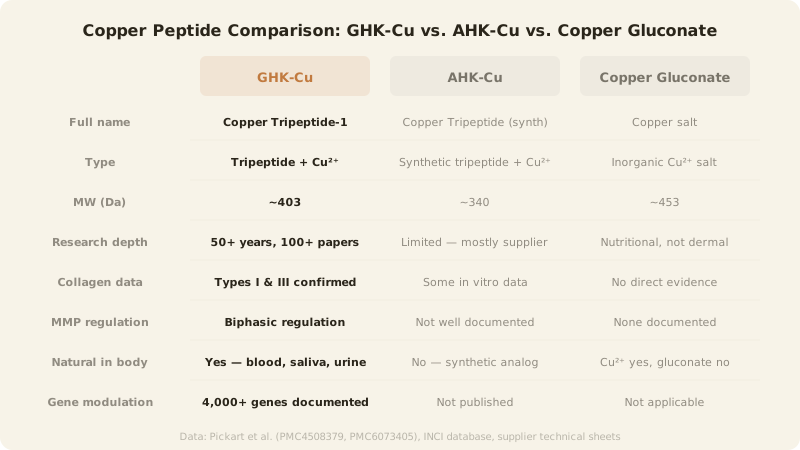
Full name: Glycyl-L-histidyl-L-lysine copper(II). INCI: Copper Tripeptide-1. Molecular weight: ~403 Da. Origin: Naturally occurring in human blood plasma, saliva, and urine. First isolated: 1973, by Dr. Loren Pickart from human albumin.
GHK-Cu is the most extensively researched copper peptide. The published evidence includes:
• Gene expression studies showing modulation of 4,000+ human genes (Pickart et al., 2015, PMC4508379)
• Collagen Types I and III synthesis stimulation in dermal fibroblasts (Pickart & Margolina, 2018, PMC6073405)
• MMP regulation for controlled collagen remodeling (Siméon et al., 2000, PMID 10886523)
• Glycosaminoglycan and decorin production stimulation (Siméon et al., 1999, PMID 10469320)
• Wound healing acceleration across multiple models (Arul et al., 2007; Canapp et al., 2003)
• Antioxidant defense gene upregulation including SOD pathways
• Anti-inflammatory action in wound models
The research spans five decades and includes contributions from multiple independent laboratories. GHK-Cu’s natural presence in human plasma (declining from ~200 ng/mL at age 20 to ~80 ng/mL by age 60) provides a biological rationale for topical supplementation that synthetic peptides cannot claim.
AHK-Cu (Copper Tripeptide-3)
Full name: Alanyl-L-histidyl-L-lysine copper(II). INCI: Copper Tripeptide-3. Molecular weight: ~417 Da. Origin: Synthetic analogue of GHK-Cu (glycine replaced with alanine).
AHK-Cu is structurally similar to GHK-Cu — one amino acid substitution (alanine for glycine). Some ingredient suppliers market it as having comparable collagen-stimulating properties based on its structural similarity and preliminary studies.
The evidence base for AHK-Cu is substantially smaller:
• No equivalent to the 4,000+ gene expression analysis that defines GHK-Cu’s broad mechanism
• Fewer independent replication studies
• No equivalent body of wound healing research
• Limited published data on MMP regulation specifically
• Not naturally occurring in human biology
AHK-Cu may have useful properties. Structural similarity to GHK-Cu provides theoretical basis for similar activity. But “may have” and “has demonstrated across five decades of research” are different evidential claims. If a product contains AHK-Cu (Copper Tripeptide-3) instead of GHK-Cu (Copper Tripeptide-1), you are getting a less-studied molecule.
Copper Gluconate
INCI: Copper Gluconate. Molecular weight: ~453 Da. Origin: A copper salt (not a peptide).
Copper gluconate is a mineral salt that delivers copper ions. It is not a peptide — there is no amino acid chain. The distinction matters because GHK-Cu’s documented effects are not simply “copper on skin.” The tripeptide component (GHK) is an active signaling molecule. The copper ion is necessary for the complex to function, but copper alone does not trigger the same cellular responses.
Copper ions participate in various enzymatic reactions in the skin, including:
• Lysyl oxidase activity (collagen cross-linking)
• Superoxide dismutase (SOD) as a cofactor
• Tyrosinase activity (melanin production)
These are real biological functions, but they represent a different — and much less specific — mechanism than GHK-Cu’s gene expression modulation and MMP regulation. Applying copper ions to the skin is not the same as applying the GHK-Cu signaling complex.
Side-by-side comparison
What this means for product evaluation
Check the INCI, not the marketing
A product that says “with copper peptides” on its front label could contain any of these three compounds — or a combination. The INCI list on the back is what tells you which one.
• Copper Tripeptide-1 = GHK-Cu (the extensively researched one)
• Copper Tripeptide-3 = AHK-Cu (the less-studied analogue)
• Copper Gluconate = a copper salt (not a peptide at all)
Marketing materials that cite GHK-Cu research while the product contains AHK-Cu or copper gluconate are misrepresenting the evidence. The studies from Pickart, Siméon, and others specifically used GHK-Cu — not its analogues or simple copper salts.
Why brands might choose AHK-Cu or copper gluconate
• Cost: GHK-Cu at pharmaceutical grade is more expensive than AHK-Cu or copper gluconate.
• Supply chain: Copper gluconate is widely available as a commodity ingredient. GHK-Cu requires specialized peptide suppliers.
• Formulation simplicity: Copper gluconate dissolves readily in both aqueous and some non-aqueous systems. GHK-Cu’s hydrophilic nature creates formulation challenges in lipid-based products (requiring liposomal encapsulation or similar technology).
• Regulatory: A less-specific “copper peptide” claim is easier to support with less-specific ingredients.
None of these reasons are about efficacy. They are about manufacturing convenience and margin.
The research transfer problem
You will encounter brands that cite GHK-Cu research in their marketing while using AHK-Cu or copper gluconate in their formulation. This is the research transfer problem — applying evidence from one compound to a different compound based on category similarity.
It would be like citing clinical trials for acetaminophen (Tylenol) to support the efficacy of a product containing ibuprofen (Advil). Both are pain relievers, both work, but the specific evidence for one does not validate the other.
If the research citations reference GHK-Cu studies (Pickart, Siméon, etc.), the product should contain GHK-Cu (Copper Tripeptide-1). If it contains something else, the cited research does not directly apply.
Frequently asked questions
Is AHK-Cu bad?
Not necessarily. AHK-Cu may have useful skincare properties — its structural similarity to GHK-Cu provides theoretical basis for activity. But “may have” is not “has been demonstrated.” The published evidence base is smaller. If a brand chooses AHK-Cu, it should be transparent about what research specifically supports that ingredient, not cite GHK-Cu studies as if they apply.
Can copper peptides replace retinol?
Copper peptides and retinoids work through entirely different mechanisms. GHK-Cu modulates gene expression through peptide signaling. Retinoids activate nuclear receptors (RAR/RXR). They address overlapping outcomes (collagen production) through non-overlapping pathways. Neither is a direct substitute for the other, and some users benefit from both.
Why don’t brands specify which copper peptide they use?
In marketing materials, “copper peptide” sounds more accessible than “Copper Tripeptide-1.” On the INCI label, specificity is required. The disconnect between front-label marketing and back-label INCI is where the ambiguity lives. Checking the INCI list resolves it.
References
Pickart, L., Vasquez-Soltero, J.M., Margolina, A. (2015)
GHK-Cu may prevent oxidative stress in skin by regulating copper and modifying expression of numerous antioxidant genes
Pickart, L., Margolina, A. (2018)
Regenerative and Protective Actions of the GHK-Cu Peptide in the Light of the New Gene Data
Siméon, A., et al. (2000)
Expression of glycosaminoglycans and small proteoglycans in wounds: modulation by the tripeptide-copper complex glycyl-L-histidyl-L-lysine-Cu(2+)
Siméon, A., et al. (1999)
Glycosaminoglycan and decorin production stimulation by GHK-Cu
Robinson, L.R., et al. (2005)
Topical palmitoyl pentapeptide provides improvement in photoaged human facial skin
Continue reading

Peptide Science
GHK-Cu Concentration in Skincare: Why It Matters
A product with 0.001% GHK-Cu and a product with 1% GHK-Cu both say “Copper Tripeptide-1” on the label. They are not the same product.
14 min read

Consumer Guide
Why Skincare Concentrations Matter (And Why Most Brands Hide Them)
You wouldn’t buy a vitamin supplement that said “Contains Vitamin D” without the dose. That’s exactly how most skincare is sold.
9 min read
Peptide Science
Peptides in Skincare: What the Evidence Actually Shows
Peptides are one of the most-marketed ingredient categories in skincare. They are also one of the most misunderstood.
7 min read
Curious about the product?