
The word “sebum” comes from the Latin word for tallow. Your skin already knows what tallow is.
Research
Skin Science16 min read
Tallow in Skincare: The Lipid Matrix Advantage
Human sebum and beef tallow share a remarkably similar fatty acid profile: roughly 50% saturated, 42% monounsaturated, and 4% polyunsaturated. This biochemical overlap makes tallow a uniquely sebum-compatible delivery vehicle. This article covers the lipid science, the grass-fed molecular difference, and why a lipid matrix outperforms aqueous formulations for getting active ingredients through your skin.
February 16, 2026
Key Takeaways
Human sebum and beef tallow share a remarkably similar fatty acid profile: roughly 50% saturated, 42% monounsaturated, and 4% polyunsaturated. This biochemical overlap makes tallow a uniquely sebum-compatible delivery vehicle. This article covers the lipid science, the grass-fed molecular difference, and why a lipid matrix outperforms aqueous formulations for getting active ingredients through your skin.
Human sebum — the oily substance your skin produces to maintain its moisture barrier — shares a remarkably similar fatty acid profile with beef tallow. Both are roughly 50% saturated fats, 42% monounsaturated fats, and 4% polyunsaturated fats. This biochemical overlap is not a marketing coincidence.
This article covers the lipid science behind tallow in skincare: the fatty acid composition data, the skin barrier model it maps onto, what grass-fed sourcing changes at the molecular level, and why a lipid matrix outperforms aqueous formulations for getting active ingredients through your skin.
The skin barrier: A lipid problem
The brick and mortar model
In 1983, Peter Elias published the foundational model of the stratum corneum in the Journal of Investigative Dermatology. He described it as a “brick and mortar” structure:
• Bricks: Corneocytes. Dead, flattened skin cells packed with keratin protein.
• Mortar: Intercellular lipid matrix. A structured arrangement of ceramides (~50%), cholesterol (~25%), and free fatty acids (~15–25%).
Everything that enters or exits your skin must pass through this lipid mortar.
What your skin’s lipid barrier is made of
The stratum corneum lipid matrix contains:
• Ceramides: The primary structural lipids.
• Cholesterol: Provides fluidity to the rigid ceramide layers.
• Free fatty acids: Predominantly palmitic acid (C16:0), stearic acid (C18:0), and oleic acid (C18:1).
Tallow and human sebum: The fatty acid comparison
Side-by-side fatty acid profiles
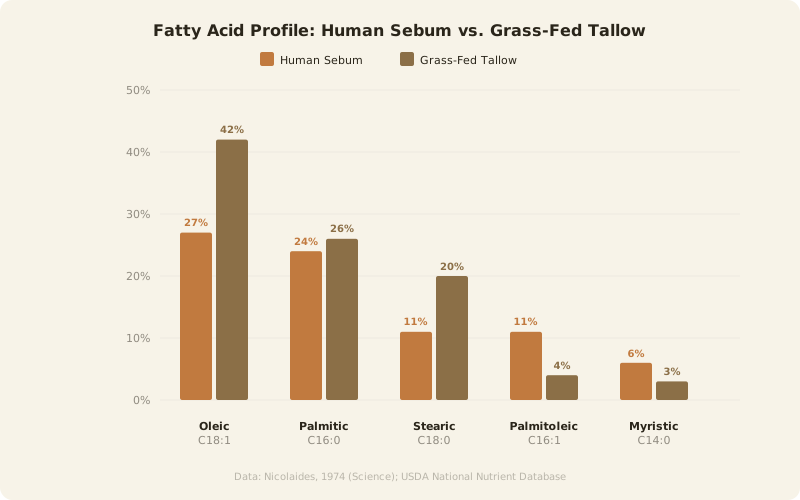
Oleic acid (C18:1): Human sebum ~25–30%, grass-fed tallow ~40–45%. Primary monounsaturated fatty acid and skin penetration enhancer.
Palmitic acid (C16:0): Human sebum ~22–25%, grass-fed tallow ~25–28%. Structural saturated fatty acid supporting barrier integrity.
Stearic acid (C18:0): Human sebum ~10–12%, grass-fed tallow ~18–22%. Structural saturated fatty acid with occlusive properties.
Palmitoleic acid (C16:1): Human sebum ~10–12%, grass-fed tallow ~3–5%. Antimicrobial fatty acid.
Myristic acid (C14:0): Human sebum ~5–8%, grass-fed tallow ~3–4%. Medium-chain saturated fatty acid.
Linoleic acid (C18:2): Human sebum ~1–3%, grass-fed tallow ~2–4%. Essential fatty acid for barrier repair.
What the numbers mean
Both sebum and tallow are roughly 50% saturated fatty acids, roughly 40–45% monounsaturated fatty acids, and low in polyunsaturated fatty acids (<5%).
This profile is fundamentally different from most plant oils. Common alternatives like argan oil (~45% linoleic), rosehip oil (~44% linoleic), and hemp seed oil (~55% linoleic) have polyunsaturated-dominant profiles that do not match sebum composition.
“When you apply tallow to your skin, its fatty acids can integrate into the existing sebum layer because they are chemically similar to what is already there.”
What tallow has that sebum doesn’t (and vice versa)
Human sebum contains wax esters and squalene that tallow lacks. Tallow has higher stearic acid content. The match is not perfect, but tallow’s fatty acid profile is closer to human sebum than nearly any plant oil alternative.
Grass-fed vs. conventional: What changes at the molecular level
The grass-fed difference
• Omega-3 fatty acids: Grass-fed tallow contains approximately 2–4x more omega-3 fatty acids.
• Conjugated linoleic acid (CLA): 2–3x more CLA, with documented anti-inflammatory properties.
• Total PUFAs: 45% fewer, resulting in a more sebum-compatible profile.
• Fat-soluble vitamins: More A, D, E, K2 due to pasture exposure.
Why this matters for skincare
More sebum-compatible fatty acid profile. Lower PUFAs mean improved oxidative stability. Higher fat-soluble vitamin content.
Suet vs. other fat deposits
Suet — the fat surrounding the kidneys — has the highest stearic acid concentration and the firmest texture. Wet-rendering preserves more vitamins and produces neutral-scented tallow.
Tallow as a delivery vehicle for active ingredients
The penetration enhancement effect
Benson (2005) reviewed transdermal drug delivery enhancement techniques in Current Drug Delivery:
• Lipid matrix disruption. Fatty acids integrate with the stratum corneum, temporarily increasing permeability. Oleic acid is a well-documented penetration enhancer.
• Occlusive hydration. A lipid layer traps transepidermal water loss, increasing stratum corneum hydration and permeability.
Why this matters for GHK-Cu specifically
GHK-Cu is hydrophilic. At ~403 Da, it’s small enough to penetrate but has no natural drive to enter the lipid-rich stratum corneum.
A lipid-based delivery vehicle addresses this through occlusion. Compare this to an aqueous serum: once water evaporates, unabsorbed peptide sits on dry skin.
Hours
A tallow matrix extends the delivery window compared to aqueous serums where water evaporates in minutes
The liposomal bridge
Liposomal encapsulation solves the water-in-fat dispersion problem. The peptide is enclosed in phospholipid vesicles that disperse in the tallow matrix, maintaining stability and releasing the peptide into the viable epidermis on application.
Addressing common concerns
Won’t tallow clog my pores?
Pure beef tallow rates approximately 2–3 on the comedogenicity scale. For comparison: coconut oil rates 4, wheat germ oil rates 5, jojoba oil rates 0–2, and mineral oil rates 0–1.
Won’t it smell like beef?
Properly wet-rendered cosmetic-grade suet tallow is white and odorless. The “beefy” smell comes from dry rendering at high temperatures or non-suet fat sources.
Isn’t this just the ancestral/paleo marketing trend?
The case for tallow depends on fatty acid biochemistry, skin barrier science, and delivery vehicle pharmacology. The Nicolaides sebum data from 1974 in Science and Benson’s 2005 penetration enhancement research predate and are independent of marketing trends.
Tallow compared to other delivery formats
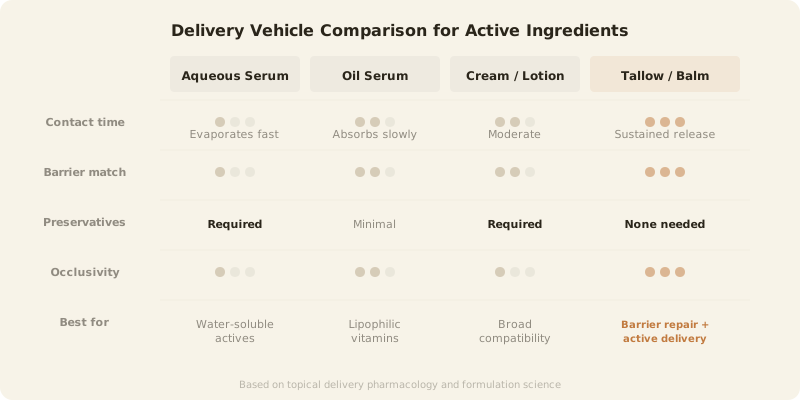
Aqueous serums
Advantages: Easy to formulate, fast absorption. Disadvantages: Short skin contact time, no occlusive benefit.
Oil serums
Advantages: Good occlusion, extended contact. Disadvantages: Cannot dissolve hydrophilic peptides.
Cream emulsions
Advantages: Both water and oil-soluble actives. Disadvantages: Emulsifiers required, water evaporates.
Tallow/balm (anhydrous lipid matrix)
Advantages: Sebum-compatible, strong occlusion, no preservatives needed, stable for encapsulated peptides. Disadvantages: Thicker texture, requires liposomal bridging for hydrophilic actives.
Frequently asked questions
Is tallow better than plant-based moisturizers?
For barrier compatibility and peptide delivery, tallow’s sebum-matching profile provides advantages. For lightweight daily hydration, plant oils or emulsions may be more appropriate.
Can vegans use tallow skincare?
No. Tallow is animal-derived. Shea butter and cocoa butter are the closest plant alternatives.
Does tallow work for oily skin?
Sebum-compatible lipids can benefit oily skin by integrating with existing sebum rather than sitting on top of it.
How should tallow skincare be stored?
Room temperature, away from direct sunlight. Anhydrous tallow products have 12–18 month shelf life without synthetic preservatives.
References
Elias, P. (1983)
Epidermal lipids, barrier function, and desquamation
Nicolaides, N. (1974)
Skin lipids: their biochemical uniqueness
Benson, H.A.E. (2005)
Transdermal Drug Delivery: Penetration Enhancement Techniques
Bos, J.D., Meinardi, M.M. (2000)
The 500 Dalton rule
Continue reading
Skin Science
Your Skin Barrier: What It Is and Why Everything Else Depends on It
Every skincare product you apply interacts with the same structure first: your skin barrier. Understanding it changes how you evaluate everything else.
5 min read

Peptide Science
The Complete Guide to GHK-Cu in Skincare
Your skin already makes GHK-Cu. It just makes less of it every year.
18 min read
Curious about the product?