
Every skincare product you apply interacts with the same structure first: your skin barrier. How that barrier functions determines whether active ingredients reach the cells that need them, whether your skin retains moisture, and whether environmental irritants stay out.
Research
Skin Science5 min read
Your Skin Barrier: What It Is and Why Everything Else Depends on It
The stratum corneum’s lipid barrier controls moisture retention, ingredient delivery, and environmental defense. This article explains the brick-and-mortar model, how damage occurs, how repair works, and what it means for the products you choose.
February 16, 2026
Key Takeaways
The stratum corneum’s lipid barrier controls moisture retention, ingredient delivery, and environmental defense. This article explains the brick-and-mortar model, how damage occurs, how repair works, and what it means for the products you choose.
Understanding the barrier changes how you evaluate products, build routines, and interpret what your skin is telling you.
The Brick and Mortar Model
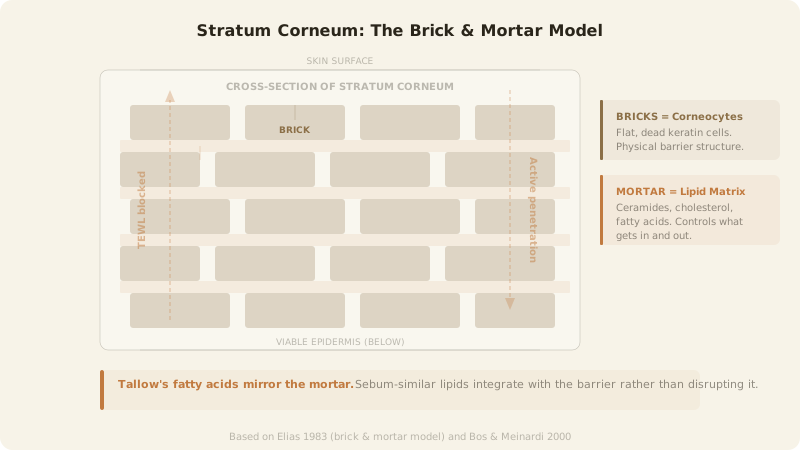
The outermost layer of your skin — the stratum corneum — was described by Peter Elias in 1983 as a “brick and mortar” structure (Journal of Investigative Dermatology).
The bricks: corneocytes. Dead, flattened cells packed with keratin protein. They are tough, flat, and stacked 15–20 layers deep.
The mortar: intercellular lipid matrix. Between the corneocytes, a structured arrangement of three lipid types creates the actual permeability barrier:
• Ceramides (~50%): The dominant structural lipid.
• Cholesterol (~25%): Provides fluidity to the rigid ceramide layers.
• Free fatty acids (~15–25%): Primarily palmitic acid, stearic acid, and oleic acid.
The ratio matters. These three lipid types exist in a roughly equimolar ratio (1:1:1) in healthy barrier function.
“The barrier is not a single wall — it is a structured arrangement of ceramides, cholesterol, and fatty acids in a precise ratio that determines whether your skin holds moisture or loses it.”
What the Barrier Actually Does
Prevents Water Loss
Without the stratum corneum’s lipid barrier, transepidermal water loss (TEWL) would dehydrate the viable skin layers rapidly. Healthy skin loses approximately 300–400mL of water per day through the skin.
Controls What Enters
• Molecular weight: Molecules above approximately 500 Daltons have difficulty penetrating intact barrier (Bos & Meinardi, 2000).
• Lipophilicity: Oil-soluble molecules navigate the lipid matrix more easily than water-soluble ones.
• Barrier integrity: Damaged or hydrated barrier is more permeable.
Hosts the Microbiome
The skin surface supports a microbial community that contributes to immune defense. The barrier’s pH (approximately 4.5–5.5) helps maintain beneficial organisms.
How the Barrier Gets Damaged
Over-Cleansing
Surfactants dissolve the lipid mortar along with surface dirt. Harsh surfactants strip ceramides, cholesterol, and fatty acids directly. Signs: persistent tightness after cleansing, redness, increased sensitivity.
Environmental Damage
UV radiation, wind, low humidity, and pollution all stress the barrier.
Product Stacking
Layering multiple active ingredients can overwhelm the barrier’s repair capacity. The total active load matters, not just individual product concentrations.
Barrier Conditions
Eczema, psoriasis, and rosacea all involve barrier dysfunction.
How the Barrier Repairs Itself
After disruption:
• Immediate response (hours): Remaining lipids redistribute to fill gaps.
• Lipid synthesis upregulation (12–24 hours): Keratinocytes increase production of ceramides, cholesterol, and fatty acids.
• Lipid secretion and organization (24–72 hours): Newly synthesized lipids organize into lamellar structure.
• Full recovery (days to weeks): Complete recovery from significant disruption can take 2–4 weeks.
What This Means for Active Ingredient Delivery
The barrier is simultaneously the problem and the tool:
• Lipid-compatible delivery: Products with sebum-matching fatty acids integrate with the mortar.
• Occlusive delivery: Lipid layers trap moisture, increasing permeability.
• Encapsulation: Liposomal systems ferry actives through the lipid matrix.
A healthy barrier delivers ingredients efficiently. A damaged barrier is more permeable but also more reactive.
Frequently Asked Questions
How do I know if my skin barrier is damaged?
Persistent dryness that does not respond to moisturizer. Stinging or burning when applying products that previously felt fine. Redness. Increased sensitivity to temperature changes.
How long does it take to repair a damaged barrier?
Two to four weeks for significant disruption. Simplify your routine during repair.
Does “more products” mean better barrier support?
Not necessarily. The barrier needs ceramides, cholesterol, and fatty acids. A single well-formulated product can provide this.
Continue reading
Skin Science
Tallow in Skincare: The Lipid Matrix Advantage
The word “sebum” comes from the Latin word for tallow. Your skin already knows what tallow is.
16 min read
Consumer Guide
How to Actually Read a Skincare Ingredient Label
The front of a skincare product tells you what the brand wants you to believe. The back tells you what is actually in the jar.
9 min read
Curious about the product?