
The front of a skincare product tells you what the brand wants you to believe. The back tells you what is actually in the jar. Most people never learn to read the back.
Research
Consumer Guide9 min read
How to Actually Read a Skincare Ingredient Label
INCI is the standardized system governing cosmetic ingredient labels. Understanding its rules — and its deliberate ambiguities — turns every product label into a data source. This guide explains descending order, the 1% line, common label patterns, INCI name translations, and red flags.
February 16, 2026
Key Takeaways
INCI is the standardized system governing cosmetic ingredient labels. Understanding its rules — and its deliberate ambiguities — turns every product label into a data source. This guide explains descending order, the 1% line, common label patterns, INCI name translations, and red flags.
INCI — the International Nomenclature of Cosmetic Ingredients — is the standardized system that governs how ingredients appear on cosmetic labels. Understanding its rules, and its deliberate ambiguities, turns every product label into a data source.
The Basics: INCI Order Rules
Above 1%: Descending Concentration
Ingredients present at more than 1% of the total formula must be listed in descending order of concentration.
For most moisturizers, the first ingredient is water (Aqua). For anhydrous formulations like tallow balms, the first ingredient is the primary oil or fat base.
What this tells you: The first 3–5 ingredients typically compose 70–90% of the product.
Below 1%: Any Order
Ingredients present at less than 1% may be listed in any order. The brand can arrange them however they choose.
What this tells you: Once you pass the 1% threshold, ingredient position is meaningless. An ingredient listed eighth and one listed eighteenth might both be at 0.5%, or one at 0.8% and the other at 0.01%.
“Once you pass the 1% line, ingredient position is meaningless. The brand can list them in any order they choose.”
The 1% Line: Where Is It?
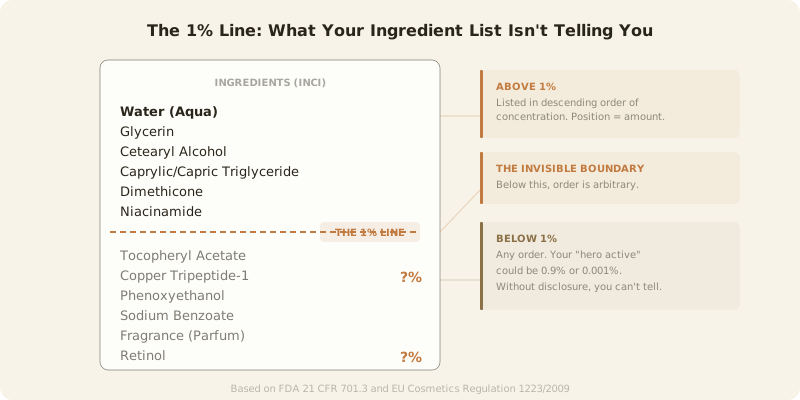
The 1% line is not marked. Identifying it requires inference:
• Preservatives typically appear at 0.5–1.0%. Phenoxyethanol is almost always at or below 1%.
• Fragrance/Parfum is typically at 0.1–1.0%.
• Tocopherol (Vitamin E) as an antioxidant is typically at 0.5–1.0%.
• Colorants (CI numbers) are well below 1%.
Decoding Common Label Patterns
The “Kitchen Sink” Formula
Pattern: 25–40 ingredients. Multiple active ingredients toward the end. What it suggests: Many ingredients at trace levels. If 30 ingredients and the base is 85%, the remaining 15% is spread across 25+ ingredients.
The “Star Ingredient” Disconnect
Pattern: Front label features one ingredient. Back label lists it near the end, after preservatives. What it suggests: The star ingredient is at trace levels — potentially below 0.1%.
The “Proprietary Complex”
Pattern: Grouped active ingredients with combined percentage but no individual breakdown. What it suggests: You cannot determine individual concentrations.
The Clean, Short Formula
Pattern: 6–10 ingredients. Clear base ingredients first. What it suggests: Each ingredient is more likely to be present at functional levels.
INCI Names vs. Marketing Names
• GHK-Cu / Copper Peptide = Copper Tripeptide-1
• AHK-Cu = Copper Tripeptide-3
• Matrixyl = Palmitoyl Pentapeptide-4
• Argireline = Acetyl Hexapeptide-3
• Methylene Blue = Methylene Blue / CI 52015
• Vitamin E = Tocopherol / Tocopheryl Acetate
• Vitamin C = Ascorbic Acid / Sodium Ascorbyl Phosphate
• Hyaluronic Acid = Sodium Hyaluronate
• Retinol = Retinol / Retinyl Palmitate
Red Flags on Ingredient Labels
“Proprietary Blend” Without Breakdown
Prevents evaluation of individual ingredient concentrations.
Active Ingredient Listed After Preservatives
Almost certainly present below 1%.
Claims Without INCI Backup
If front says “copper peptide” but no copper ingredient appears on INCI list.
Excessively Long Ingredient Lists
The math of concentration works against long lists when every ingredient is supposed to be “active.”
“If a product lists 30 ingredients and the base accounts for 85%, the remaining 15% is spread across 25+ ingredients. Do the math.”
A Practical Label-Reading Exercise
• Identify the base (first 3–5 ingredients)
• Find the 1% line (look for preservatives)
• Locate the “star” ingredient (above or below the 1% line?)
• Count the ingredients
• Check for disclosure
• Compare INCI to claims
Frequently Asked Questions
Are longer ingredient lists worse?
Not inherently. The concern arises when many active ingredients are listed below 1%.
Do I need to memorize INCI names?
No. A few key names help. Databases like INCIdecoder.com provide lookup tools.
Can I trust “fragrance-free” labels?
“Fragrance-free” means no ingredients added for scent. Some natural fragrance may still be present for functional purposes. Check the INCI list.
Continue reading

Consumer Guide
Why Skincare Concentrations Matter (And Why Most Brands Hide Them)
You wouldn’t buy a vitamin supplement that said “Contains Vitamin D” without the dose. That’s exactly how most skincare is sold.
9 min read
Peptide Science
GHK-Cu vs. Other Copper Peptides: What the Research Shows
"Copper peptide" is a category, not an ingredient. Three compounds carry the label — and their evidence bases are not interchangeable.
10 min read
Peptide Science
GHK-Cu Concentration in Skincare: Why It Matters
A product with 0.001% GHK-Cu and a product with 1% GHK-Cu both say “Copper Tripeptide-1” on the label. They are not the same product.
14 min read
Curious about the product?